1. Skip to content
  2. Skip to navigation

Ancient or Medieval History with The Civic Mirror (middle school)

Although The Civic Mirror does not directly connect to the middle school curriculum for ancient history and/or medieval times, it could most definitely be used to help students  compare and contrast the social, political, and economic systems and structures between  then and now.

The two modules that have been developed for The Civic Mirror are the U.S. and Canadian modules. More modules will be developed in the future, but, for now, this idea could be an exciting option for middle school ancient or medieval history teachers wanting to utilize the Civic Mirror.

COMPARING ANCIENT or MEDIEVAL SOCIETIES WITH MODERN SOCIETY
With this idea, you could stretch the 10 activities outlined in the “Civic Mirror in 10 Days” scope and sequence over a period of 4-10 weeks, matching specific studies of various aspects of ancient or medieval societies with Civic Mirror events in order to allow for modern-day comparisons.

What I like about this is it would get the students thinking about their world today, how it compares/contrasts to ancient or medieval societies, and it would allow students to understand – through experiential reflection – just how far civilization has (and hasn’t) advanced from those times.

What I also like about this idea is that history curricula are usually grounded in the notion that students will better understand the world today by studying the world as it was. This unit idea brings that desired cognitive leap to the foreground, providing students with a better understanding of how society works today (by experiencing a simulated version of it with The Civic Mirror), which will in turn provide them with a better ability to understand the various components of historic societies too.

To illustrate this, we have provided some essential questions that students could be asked about ancient and/or medieval societies before, during, and after their participation in each of The Civic Mirror’s events. Before reading the examples that follow, open up and have handy “Civic Mirror in 10 Days.”

SOCIAL IDENTITY ~ When the students create their simulated country’s identity, you could ask some inquiry questions about who were the ________ people (e.g. Roman, medieval, etc.)? What kind of communities did they live in? Did they view themselves as citizens, like we do, or something different? How is our nation today similar and different to the ancient/medieval society we’re studying? Etc.
CHOOSING LEADERS ~ When students elect their government using the modern democratic procedures outlined in the Civic Mirror Manuals, students could be asked … How were leaders chosen in ancient or medieval society? How are leaders elected today? What method is better, more fair?  Etc.

PROPERTY OWNERSHIP ~ When your students bid to own their country’s property in the Hex Auction (the last pre-game event), you could ask them … Who were the landowners in ancient/medieval society? How did they come to own their land? Was everyone allowed to own land and property? How is this different and similar to your simulated country? To our country today? Etc.


GOVERNANCE ~ When the student politicians work to pass laws and set policies in the Government Event, you could ask … How were laws made and enforced in ancient/medieval ages? Who was allowed to vote and participate? How are things similar/different in our society today? Etc.

LAW & PUNISHMENT ~ When the students are using their own impartial and democratic court in the Civic Mirror, you could ask them … Who determined guilt and innocence in ancient/medieval times? Were their powers limited or unlimited, and what dangers, threats, and/or benefits did the people in those ages face as a result? How are things similar/different today? What’s better? Etc.

CURRICULUM COVERAGE & INTEGRATION IDEAS
If you’re wondering how you could integrate The Civic Mirror into your course and fit all of the required readings into your time line, please read our Teaching with The Civic Mirror Overview for suggestions and ideas.
Posted in CM News | Tagged , , , | Comments Off on Ancient or Medieval History with The Civic Mirror (middle school)

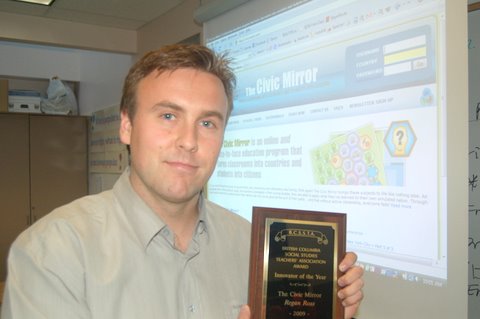
BCSSTA Awards Civic Mirror the 2009 Innovation of the Year

At the 2009 BC Social Studies Teachers Association’s Annual Conference, president Raquel Chin awarded Regan Ross with the “Innovator of the Year” award for developing The Civic Mirror and working with teachers to integrate it into their classrooms.

This is the second award Regan has received for his pioneering work with The Civic Mirror, the first being the Prime Minister’s Certificate of Teaching Excellence in 2008.

Posted in CM News | Tagged , , | Comments Off on BCSSTA Awards Civic Mirror the 2009 Innovation of the Year

Civic Mirror Workshop at the 2009 BC Social Studies Conference

Regan Ross and Lizanne Foster, teachers from the Surrey School District and CM Pioneers, will be teaching BC educators how to use The Civic Mirror by playing it in a double session at the 2009 BCSSTA Fall Conference! Teachers interested in enlivening their social studies course with an experience-based, 21st Century learning tool would do well to attend this session!

Participants will be given a fictitious family to care for by providing them with food, shelter, education, health care and more. They’ll also be given a hidden agenda; will elect a their own government who will set tax rates and make laws; will bid to own national assets in an auction; will buy, trade, and sell in an open market; and will have the opportunity to sue anyone – including their government – for breaking the law.

By playing The Civic Mirror, participants will learn:
* Its game rules and major events,
* How the online program works and how it sets up classroom events,
* How to use its Web2.0 tools to extend learning outside the classroom,
* How to capitalize on the teachable moments it provides (related to law, government, economics, and active citizenship)

The Civic Mirror fits the curricular needs of the following BC social studies courses:
* entire Grade 6 social studies course
* Social Studies 10
* Social Studies 11
* Civic Studies 11
* Economics 12
* Law 12

Posted in CM News | Tagged , | Comments Off on Civic Mirror Workshop at the 2009 BC Social Studies Conference

Introducing the New Civic Mirror Trenches Writer

I’m proud to introduce to the world, the new CM Trenches researcher and writer, Sarah Connor.   Hello all Civic Mirror players and instructors!  I am a Social Studies/History teacher from Washington State and yes, I can fight robots from the future.  I am excited to begin sharing the exciting news coming out of our Civic Mirror countries!  Keep up the good work everyone and watch for posts; I know there will be a lot of exciting experiences and lessons to share!

Posted in CM News | Tagged , , , | Comments Off on Introducing the New Civic Mirror Trenches Writer

A Student Case Study: Jordan’s Story Civic Mirror Classroom Video Series, Episode 20

Reflection & Connection

Reflection & Connection

This is a student video reflection that was done for marks. The young man’s name is Jordan, his track record in school was less than stellar, and his experience in The Civic Mirror was full of adversity.

What’s so fascinating about this case study is that Jordan, who remained relatively behind the scenes throughout all of the Civic Mirror events until the National Court (Episode 17), demonstrates just how much he learned and discovered throughout the entire process.

This video doesn’t show Jordan at home doing social studies reading and note-taking for the first time in preparation for the cash-related reading checks (Episode 5); it doesn’t show him earning 83% on the multiple-choice section of the course’s standardized exam; and it doesn’t show him debating with his classmates and teachers about political and economic policy and human nature (see end of Episode 19).

But this video does show the piercing insights Jordan quietly arrived at after participating in The Civic Mirror … and being challenged to think deeply about the events, their significance, and how they relate to the course content, his world, and the world out there.

I couldn’t think of a better way to conclude this 20-episode classroom video series. I hope you enjoyed it!

DO YOU HAVE QUESTIONS OR COMMENTS ABOUT THIS CIVIC MIRROR VIDEO TUTORIAL?
Please leave them below and join the discussion!

ARE YOU WONDERING WHAT THE CIVIC MIRROR IS?
Basically it’s a government and economics simulation that turns classrooms into countries and students into citizens. Far more than just a game, The Civic Mirror is a fully comprehensive civic education program that turns the old rules of teaching and learning on their head. Students actively assume real-world citizenship roles – both in the classroom and online – and work as individuals to provide for imaginary families and achieve hidden agendas, while working together to build a strong, democratic nation.

FOR MORE INFORMATION, VISIT CIVICMIRROR.COM.

FOR THE COMPLETE CIVIC MIRROR EVENT SUMMARY, CLICK HERE .

Posted in CM News, From the CM Trenches, Student Reflections | Tagged , , , , , | Comments Off on A Student Case Study: Jordan’s Story Civic Mirror Classroom Video Series, Episode 20

Lessons Learned from the Simulation Civic Mirror Classroom Video Series, Episode 19

Reflection & Connection

Reflection & Connection

This video shows a class discussion that took place after the students completed their final Reflection and Connection assignment. The students were asked to think about all that they experienced throughout the simulation, and then connect the major ‘lessons-learned’ to their own lives, the real world, and the course content. The whole process generated some outstanding revelations (as the video illustrates).

We highly recommend teachers budget time for culminating Reflection & Connection activities like this one. They bring closure to The Civic Mirror experience, they bring participants together, and they help students share and crystallize some of the important lessons they learned along the way. And, should you be wondering, the Instructors Manual and the online repository of Civic Mirror teaching ideas have some great Reflection & Connection activity ideas that you can pick and choose from.

DO YOU HAVE QUESTIONS OR COMMENTS ABOUT THIS CIVIC MIRROR VIDEO TUTORIAL?
Please leave them below and join the discussion!

ARE YOU WONDERING WHAT THE CIVIC MIRROR IS?
Basically it’s a government and economics simulation that turns classrooms into countries and students into citizens. Far more than just a game, The Civic Mirror is a fully comprehensive civic education program that turns the old rules of teaching and learning on their head. Students actively assume real-world citizenship roles – both in the classroom and online – and work as individuals to provide for imaginary families and achieve hidden agendas, while working together to build a strong, democratic nation.

FOR MORE INFORMATION, VISIT CIVICMIRROR.COM.

FOR THE COMPLETE CIVIC MIRROR EVENT SUMMARY, CLICK HERE .

Posted in CM News | Tagged , , , | Comments Off on Lessons Learned from the Simulation Civic Mirror Classroom Video Series, Episode 19

Final Reflections Civic Mirror Classroom Video Series, Episode 18

Reflection and Connection

Reflection and Connection

We cannot overstate how easy it is for instructors to overlook the Reflection & Connection component of the The Civic Mirror learning process, and the reasons are understandable. But one of the most important skills we can teach our students is to meaningfully reflect on present experiences. By doing so we are not only teaching our students how to discover valuable lessons from their experiences, but we are also enabling them to connect those lessons-learned to things they already know about themselves and their world.

This video shows a reflection activity we did after The Civic Mirror ended. The students were first asked to position themselves relative to one another with respect to where they fell on the left-right political spectrum. Then I asked them (in almost post-reality-TV-show-style) to comment on a series of questions about government, economics, and human nature. It was a great activity, and one that generated some wonderful thoughts and insights … some which I would argue most adults would be hard-pressed to arrive at.

DO YOU HAVE QUESTIONS OR COMMENTS ABOUT THIS CIVIC MIRROR VIDEO TUTORIAL?
Please leave them below and join the discussion!

ARE YOU WONDERING WHAT THE CIVIC MIRROR IS?
Basically it’s a government and economics simulation that turns classrooms into countries and students into citizens. Far more than just a game, The Civic Mirror is a fully comprehensive civic education program that turns the old rules of teaching and learning on their head. Students actively assume real-world citizenship roles – both in the classroom and online – and work as individuals to provide for imaginary families and achieve hidden agendas, while working together to build a strong, democratic nation.

FOR MORE INFORMATION, VISIT CIVICMIRROR.COM.

FOR THE COMPLETE CIVIC MIRROR EVENT SUMMARY, CLICK HERE .

Posted in CM News | Tagged , , , , | Comments Off on Final Reflections Civic Mirror Classroom Video Series, Episode 18

National Court (Fall 2000) Civic Mirror Classroom Video Series, Episode 17

National Court

National Court

This video shows the fourth and final event of every simulated year, the National Court. In this event, any citizen may take any other citizen or organization (including the government) to court for breaking the law and/or a contract.

The Civic Mirror’s National Court is a mock trial on steroids. The stakes are real. Often hard-earned money and property are on the line. Other times it’s pride. And judges have even been known to sentence citizens to jail (which, in true Civic Mirror tradition, is sitting in the hallway while everyone else participates in class).

The National Court event is educationally potent. It teaches students that their constitution and their laws are only as good as their courts’ ability to uphold them. After all, an ignored law is not much of a law at all.

More than that, though, students are given the experiential opportunity to learn that upholding law and order takes effort, courage, and a willingness to stand up for themselves and what they believe is “right.” There have been many, many democratic Civic Mirror nations that have slipped into the clutches of ruthless individuals because their courts were either corrupt or underused. In fact, these trials can be so important that the temptation for some students to bribe or intimidate jurors and judges is very real. Actually, just watch this video. Kind of sounds like real life, doesn’t it?

DO YOU HAVE QUESTIONS OR COMMENTS ABOUT THIS CIVIC MIRROR VIDEO TUTORIAL?
Please leave them below and join the discussion!

ARE YOU WONDERING WHAT THE CIVIC MIRROR IS?
Basically it’s a government and economics simulation that turns classrooms into countries and students into citizens. Far more than just a game, The Civic Mirror is a fully comprehensive civic education program that turns the old rules of teaching and learning on their head. Students actively assume real-world citizenship roles – both in the classroom and online – and work as individuals to provide for imaginary families and achieve hidden agendas, while working together to build a strong, democratic nation.

FOR MORE INFORMATION, VISIT CIVICMIRROR.COM.

FOR THE COMPLETE CIVIC MIRROR EVENT SUMMARY, CLICK HERE .

Posted in CM News | Tagged , , , , | Comments Off on National Court (Fall 2000) Civic Mirror Classroom Video Series, Episode 17

Traditional Instruction Civic Mirror Classroom Video Series, Episode 16

Action-Ed's Philosophy

Action-Ed's Philosophy

A common misconception many people have about The Civic Mirror (and other game-based learning programs) is that it replaces traditional instruction – those moments where teachers explain key facts and concepts to their students. Nothing could be further from the truth.

In fact, if you look at the various Civic Mirror course packs and unit plans we’ve put together, you’ll see that we recommend educators devote a significant amount of time for good ole’ instruction and discussion. And referencing the “Reflection & Connection” piece that we believe is so important, most of the teachable moments the program provides would remain “untapped” unless fleshed out by the educator.

Another important point, as this video demonstrates, is that The Civic Mirror helps to make course readings more relevant and meaningful: Students can use and apply what they’re reading to their own country/citizen scenario. For example, the lecture shown in this video about the legal system was intentionally scheduled to occur right before the students’ first National Court event when their interest in the subject matter would be at its highest. As a result, the text became a playbook full of information and strategies the students could use in their own simulated scenario.

In sum, The Civic Mirror does not replace traditional instruction. If anything, it makes it more potent and relevant for students who would otherwise have no arena to use what they’re learning.

DO YOU HAVE QUESTIONS OR COMMENTS ABOUT THIS CIVIC MIRROR VIDEO TUTORIAL?
Please leave them below and join the discussion!

ARE YOU WONDERING WHAT THE CIVIC MIRROR IS?
Basically it’s a government and economics simulation that turns classrooms into countries and students into citizens. Far more than just a game, The Civic Mirror is a fully comprehensive civic education program that turns the old rules of teaching and learning on their head. Students actively assume real-world citizenship roles – both in the classroom and online – and work as individuals to provide for imaginary families and achieve hidden agendas, while working together to build a strong, democratic nation.

FOR MORE INFORMATION, VISIT CIVICMIRROR.COM.

FOR THE COMPLETE CIVIC MIRROR EVENT SUMMARY, CLICK HERE .

Posted in CM News | Tagged , , , | Comments Off on Traditional Instruction Civic Mirror Classroom Video Series, Episode 16

Town Hall (Summer 2000) Civic Mirror Classroom Video Series, Episode 15

Town Hall

Town Hall

This video shows students participating in a Civic Mirror Town Hall, the third event in every simulated year. These events are very loose meetings that allow all citizens to voice their frustrations and concerns to everyone in the country. This is the event where students are encouraged to look one another in the eyes and respectfully demand things for their family, demand things from their government, and demand things of one another. Students learn how to debate and deliberate, and why it’s important to be active and vocal citizens (those who speak are heard).

The Town Hall repeats the same two-step procedure until there are 10 minutes left, or until no one has anything left to say. The National Judge then asks if there will be any trials, and records all of the lawsuit / criminal accusations that are announced, in preparation for the National Court (the next event).

DO YOU HAVE QUESTIONS OR COMMENTS ABOUT THIS CIVIC MIRROR VIDEO TUTORIAL?
Please leave them below and join the discussion!

ARE YOU WONDERING WHAT THE CIVIC MIRROR IS?
Basically it’s a government and economics simulation that turns classrooms into countries and students into citizens. Far more than just a game, The Civic Mirror is a fully comprehensive civic education program that turns the old rules of teaching and learning on their head. Students actively assume real-world citizenship roles – both in the classroom and online – and work as individuals to provide for imaginary families and achieve hidden agendas, while working together to build a strong, democratic nation.

FOR MORE INFORMATION, VISIT CIVICMIRROR.COM.

FOR THE COMPLETE CIVIC MIRROR EVENT SUMMARY, CLICK HERE .

Posted in CM News | Tagged , , , , | 1 Comment